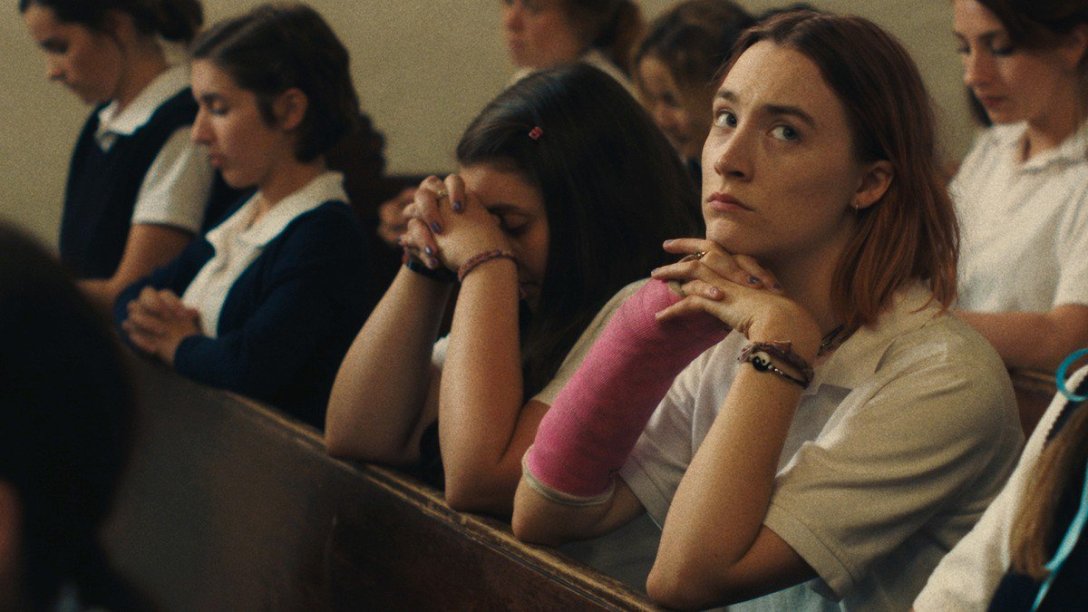
Among the long list of films in Hollywood’s history and even among Hollywood films today, Greta Gerwig’s directorial debut Lady Bird is a bit of an oddball in a lot of ways. And that’s a very good thing.
It’s a woman’s coming-of-age film in a historically-male genre of filmmaking. Gerwig herself has said she wanted Lady Bird to be a counterpart to landmark films of the genre like François Truffaut’s The 400 Blows or Richard Linklater’s Boyhood, and she accomplishes this with an effortless mastery of the craft that rivals the best of its class while bringing something new and fresh to the form. It exists in conversation with its male counterparts, not in resistance to them. It’s one of those rare gems of cinematic brilliance that’s so intentional in the way it expresses itself while being so natural in its execution that it avoids all preachiness or pretense.
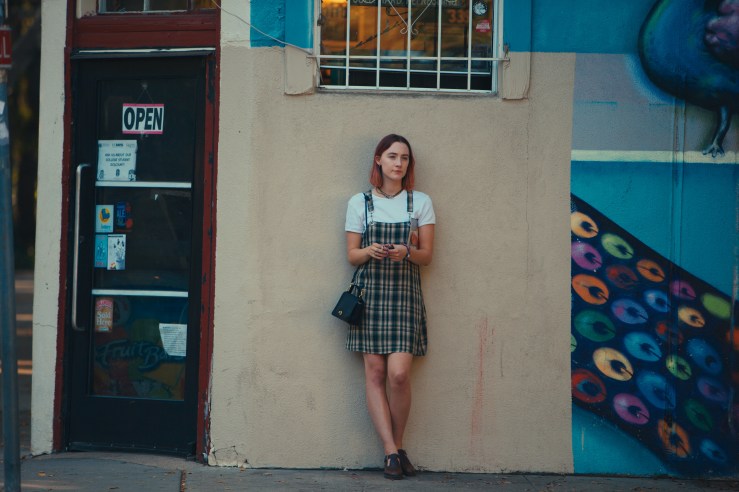
A large reason why Christine/Lady Bird’s coming-of-age story feels so organic stems from how Gerwig structures her film, not simply in the sense of plot but in the way she tells Christine’s story visually. Her use of montage in the film in particular is ubiquitous and certainly unusual. In other films written by Gerwig such as her partner Noah Baumbach’s film Frances Ha, her fondness for montage definitely shows. But after watching Lady Bird for the first time, I was convinced that Gerwig finds montage to be the ultimate form of visually expressing what it’s like to grow up.
A Movie Made of Montages
For most movies—especially coming-of-age films—it’s pretty common to find one or two montages placed between longer scenes throughout the film to express a lot of information, events, or actions in a short amount of time; usually set to some music (think John Hughes’ The Breakfast Club, for example. Wes Anderson loves a good montage too). Lady Bird is the polar-opposite story: it feels like a film almost entirely made up of montages, with the occasional longer scene in between to highlight particular exchanges or events in Christine’s life.
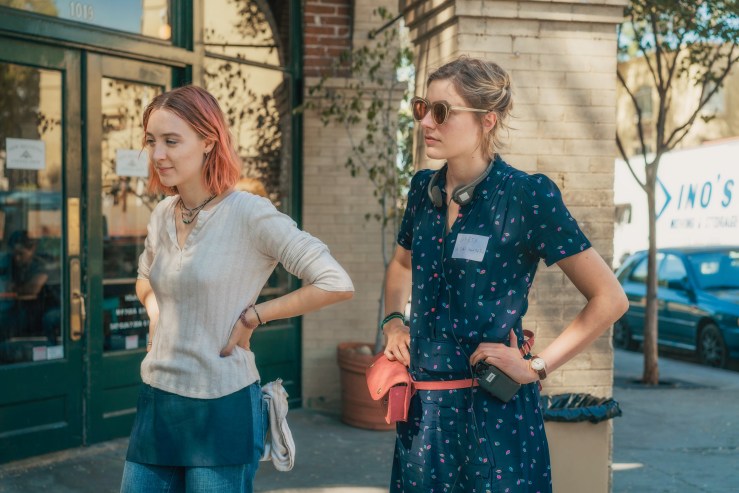
This makes the film’s pacing especially frantic at times; with the montages and Lady Bird‘s brisk ninety-three minute runtime, the film just whizzes by, but it makes sense when we’re following a high schooler’s steps into adulthood. Most of the montages focus on Christine and involve a lot of events within a large span of time, and Gerwig’s very deliberate about how they operate in the film. Some montages span entire days while others take place over the course of a whole month or two; sometimes the montages feel very structured and constructed, other times the montages feel almost documentary or cinéma vérité. Using montage to quickly present personal growth isn’t exactly innovative, but the frequency and the stylistic choices behind these montages make Gerwig’s vision for Lady Bird especially interesting.
It’s also important to note that while we mostly follow Christine’s rites of passage, Lady Bird occasionally invites us to view her mother Marion’s experiences through montage as well, and the way Gerwig structures these in tandem with Christine’s montages is very telling about how two women in different stages of life experience time and the everyday in very different ways.
A Tale of Two Women
After Christine jumps out of the car at the start of the film, the first montage of many plays over the opening credits, capturing snapshots of the first day of classes at Christine’s Catholic private school, Immaculate Heart. Compare that to one of the rarer instances of a montage focusing on Marion that comes soon after: Marion gently smiles and admires the view, driving home from work during a Sacramento golden hour with John Hartford’s “This Eve of Parting” playing softly in the car. Later montages with Christine essentially let us sit-in through hours of theatre auditions and workshops and rehearsals of a high-school production of Merrily We Roll Along within minutes. Another set of montages show us the rise and fall of Christine’s first relationship during the performances of the musical. Skip ahead a solid fifteen seconds and we see Christine opening Christmas presents, submitting stuff for college, and celebrating the new year over three shots.
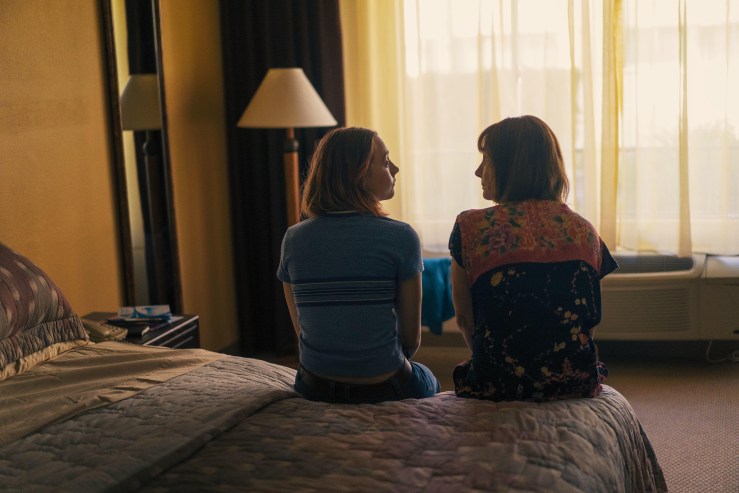
Just looking at how vastly different the passage of time is illustrated between Christine and Marion tells you so much about them. Christine’s growing up, she’s seventeen going on eighteen. She’s eager to experience life and eager to become an adult so she can distance herself away from Sacramento (“the Midwest of California”) and her mother. She has so many new things happening to her that it’s almost like she starts to lose track of it all; we start to lose track of it all.
That first thirty-second montage alone with Marion in the car set to “This Eve of Parting” characterizes her a great deal: she experiences a single moment of solitude in transit from one place of work to the next, from the hospital to her own home. Gerwig brings our attention to just how fleeting her solace is by having the John Hartford song abruptly cut to Marion slamming the car door when she gets home. Marion knows what “day-in, day-out” means. She’s a mother of practically three children after she takes Miguel’s girlfriend into the family. She’s able to take the time to appreciate the Sacramento sunset and embrace it for what it is, even with all her priorities as a mother and a nurse. She’s “warm but also kind of scary.”
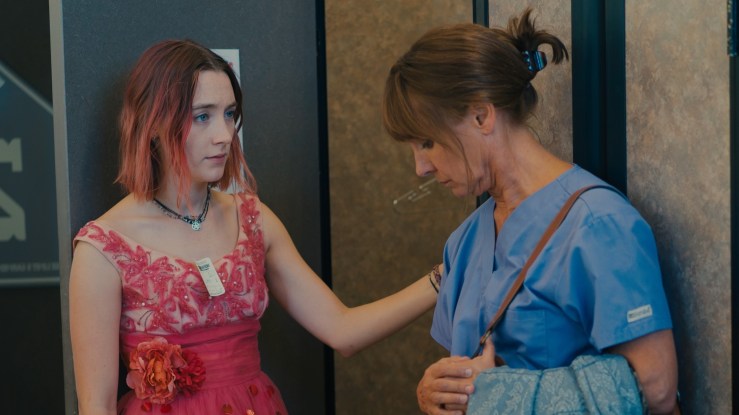
It really drives home how Christine and Marion have “such strong personalities” as Christine’s dad Larry puts it. Whenever these personalities collide, they tend to happen outside of these montages; a good portion the film’s dialogue is reserved for just the two of them. Thanks to how often Gerwig uses montage in Lady Bird, sometimes the conversations (usually arguments) between Christine and Marion feel uncomfortably long, and Gerwig lets these play out for full effect. When Marion finds out about the waitlist and Christine begs her to say something, Gerwig leaves it as a single long take, slowly dollying in towards them, and it feels like an eternity.
A Summer Gone
It’s no surprise then that the moment the two women finally converge in the same montage, they’re drifting apart. “This Eve of Parting” plays again. Entire months pass. Christine’s dad talks about refinancing the house to prepare for Christine’s college payments. Christine paints over the pink walls of her room and over the names of the boys she’s dated; she’s focusing on her personhood now, not romance. Marion struggles to write a goodbye letter. The last shot of the montage shows Marion watching the Sacramento sunrise on the drive to the airport, recalling the first montage featuring her with the same John Hartford song. But Christine’s departure brings new meaning to the song and the sunrise for her, and she can barely hold back her tears.
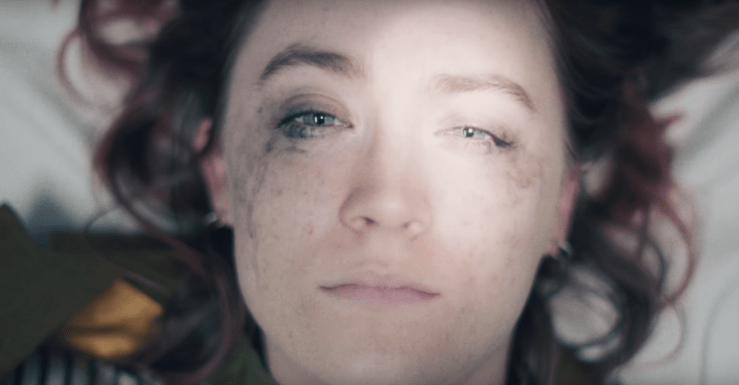
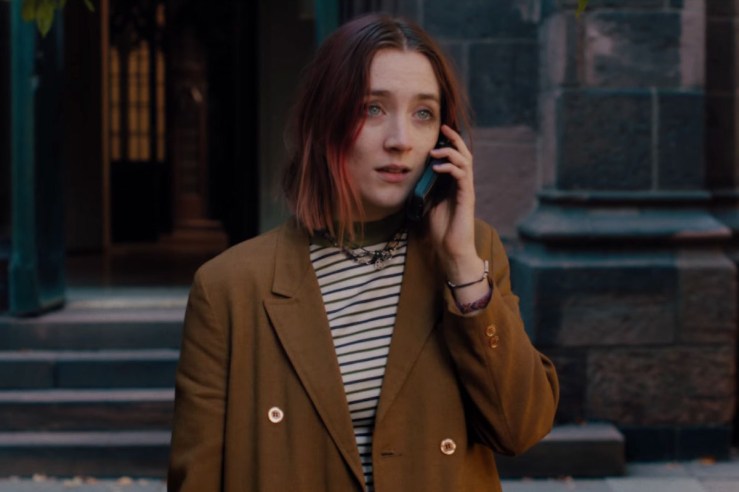
After Marion refuses to see Christine off to college, we’re given another slower set of shots focusing on Marion as she has a change of heart and turns back. Once again, Gerwig devotes a great deal of time to showing what Marion’s experiencing, allowing her emotions to really sink in for the audience. Her change of heart happens before our very eyes as the tears begin to fall from hers. Meanwhile Christine gets a quick montage of her leaving California and arriving in New York City, and another amusing one shortly after with her drinking too much and getting hospitalized. The shift from a mother’s heartbreak to the optimism of city life is shattered by the admittedly comic reality of adulthood.
Right before the final shot of Lady Bird, Gerwig once again brings Marion and Christine together through montage. But this time we’re shown a Woody Allenesque city-symphony of Sacramento during the golden hour. We’re shown Christine enjoying the sunset on her first drive through the city. She drives through the same roads as her mother and becomes more like her, appreciating the little things about Sacramento. We see Christine literally becoming Marion through match-cut. And then Christine says “thank you.”
It’s Like Magic
Usually when we’re shown a montage, it’s kind of the screenwriter or director’s implicit way of skipping ahead to pivotal plot events. It’s like the filmmaker saying “let’s get through this quick so we can get to the good part.” In a way, that’s what it’s like growing up as a teenager. It’s how Christine feels about growing up. She wants grow up and become an adult already. She wants to remove herself from what she associates with living an unsophisticated and unexciting life. And suddenly she’s introduced to so many new things about life that everything just flies by her.
By saturating her film with montages of Christine’s life and juxtaposing them with slower montages of Marion’s experience, Gerwig is not only bringing us a candid presentation of what it’s like to become an adult and be an adult. She’s rejecting the notion through her film grammar that growing up is all about looking ahead to adulthood. She takes advantage of the economy of montage to show the sheer multitude of things we experience when we grow up. But she’s not trying to skip anything. She’s saying all of the things we’ve seen Christine go through, all of it is valuable.
It’s not about “getting to the good part.” It’s Gerwig saying to Christine, to us: “Look at all of these things you’ve done along the way. You lived this. Isn’t it like magic? Isn’t it just grand?”


 chekhovsraygun.com
Loved it oh so very much. Nice review.
LikeLike